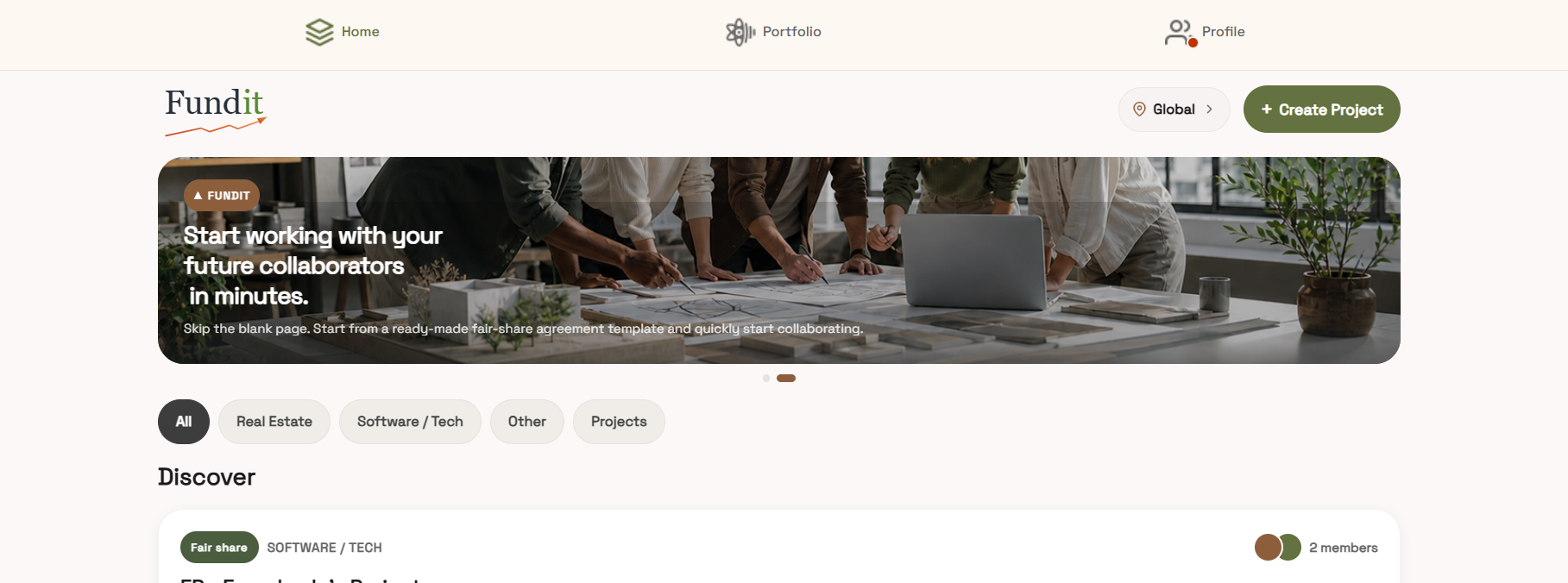
Fundit - Fair
Fundit started from a problem I kept hitting on side projects: people want to build things together long before there is any money to pay anyone. So you split ownership upfront based on a feeling and hope it holds. It usually does not. The person who promised weekends goes quiet, someone else does most of the heavy lifting, and six months later the agreement on paper has nothing to do with what actually happened. I wanted the split to be a result, not a prediction. On Fundit a project starts at zero. Contributions get logged, reviewed by the people you work with, and turned into units, and your share is simply your piece of the total. It moves as the work happens, so the paperwork stops being a guess.
My Role: End-to-End Development and Leadership
I was product owner and developer on this one, from the first sketch of the ownership model to the production deployment. The hard part was never the code, it was deciding the rules. How does a contribution become units? What happens when someone joins late? How does a founder keep a fixed share without making everyone else’s stake meaningless? On the technical side it is React Native with TypeScript, one codebase covering iOS, Android, and the fundit.dev web app, with React Navigation for routing. Supabase handles Postgres, auth, and row-level security. Agreements are versioned and locked by hash at the moment someone accepts, so what they agreed to can be proven later. Jest covers the unit tests, Maestro covers the end-to-end flows, and the web app is containerized with Docker and served through nginx.
Core Functionality Highlights
Here are some of the notable features of Fundit:
Two ways to split a project: Fully dynamic, where everything follows contributions, or hybrid, where a founder keeps a fixed percentage and the rest is earned. Projects can split equity or profit, and hourly rates adjust by role and by where the contributor lives.
Contributions that have to be earned: A project starts at zero units. Nothing exists until work is logged and approved by other members, so there is no way to hand yourself a head start.
Public projects with an open door: A project can be listed publicly so people can read the rules and the agreement summary before requesting to join, but also making it easier to find new collaborators.
End notes
Many collaborations fall apart over lack of unfair, unmotivating split and some won’t say it out loud. Fundit is my attempt at making that conversation unnecessary by gamifying the system in a way that contributors ear contribution credits based on the value they bring to the project.